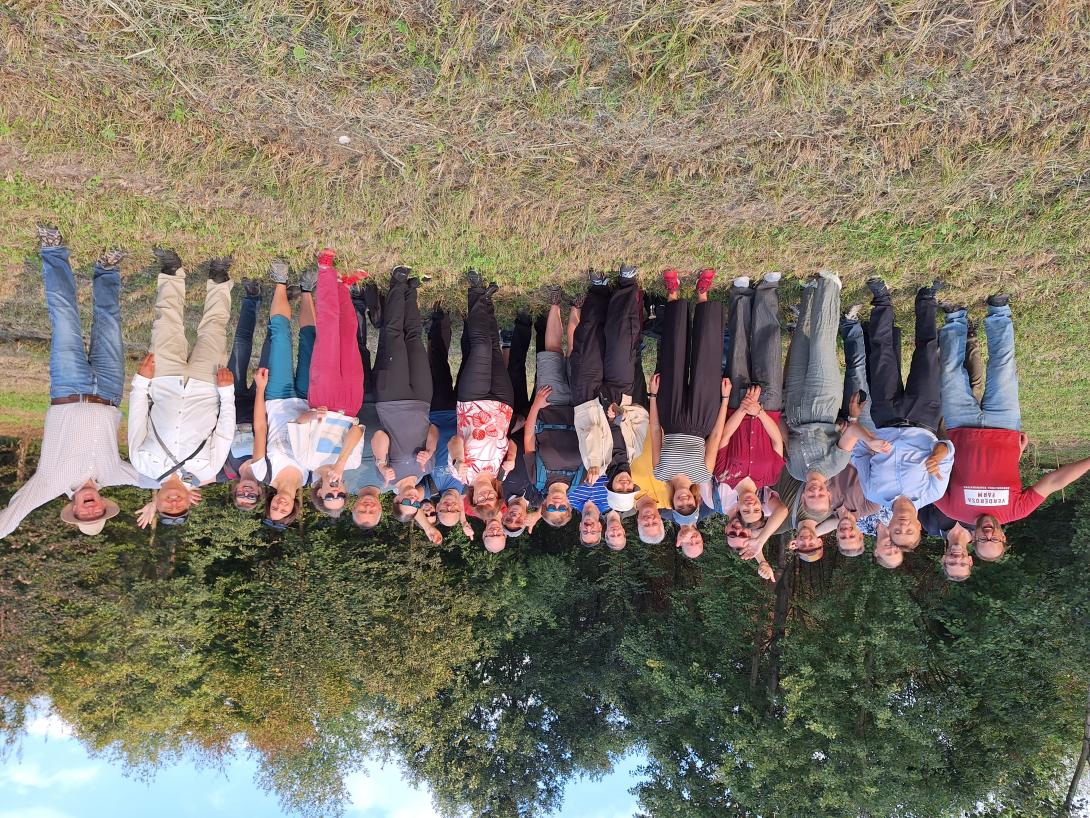
The SpongeScapes team gathered in Padua, Italy, from 15 to 17 September for three days of discussions, exchange and field visits as the project enters its final year of implementation.
Hosted at Corte Benedettina, a former monastery dating back to the 15th century and now used by the University of Padua, the General Assembly brought partners together to review progress and look ahead to the months ahead, when the project’s monitoring and modelling results, guidance, toolkits and other outputs will come together.
Seeing sponge measures in action
The meeting included a series of field visits to sponge measure case studies in and around Padua. Partners visited rain gardens at the University of Padua’s Agripolis campus, a retention pond on a rural farm in the Municipality of Schio, and rain gardens, bioretention systems and swales in the urban area of Santorso. The programme also included a visit to the Bosco Limite case study, providing an opportunity to discuss how different types of interventions on a farmer agricultural plot can contribute to store more groundwater and increase biodiversity.
The visits offered a valuable opportunity to move beyond presentations and see how sponge measures interact with real landscapes, communities and land uses.
More than technical solutions
Some of the most interesting discussions during the meeting went beyond the technical aspects of sponge measures.
One recurring message was the need for a cultural shift in the way we manage our environment. As one SpongeScapes partner noted: “It's not only a money problem; the culture is not confident enough in how to manage more natural conditions of our lands and environment.”
The exchanges also highlighted the role people can play in reconnecting with and supporting nature. In Greece, for example, people visiting areas with check dams associated the structures with landscapes and practices remembered from their grandparents. At Bosco Limite, old and rotting trees provide habitats for edible snails—an unexpected example of how biodiversity can also create connections with people's everyday lives.
These observations underline an important aspect of the SpongeScapes approach: building sponge landscapes is not only about physical measures, but also about how people understand, use and value their environment.
Looking ahead to the final year
With the final year of implementation now underway, the project is entering an important phase. Results from monitoring and modelling activities will provide new insights into the performance and potential of sponge measures, while guidance, toolkits and other outputs will help translate the project’s findings into practice.
The Padua meeting was therefore not only a moment to look back at what has been achieved, but also to prepare for the work still ahead.
And there was some media interest too: Rai (Radiotelevisione Italiana) joined the field visits in the Veneto region to report on the work. Keep an eye on Rai’s broadcasts and replay platforms for more insights from the SpongeScapes field visits.