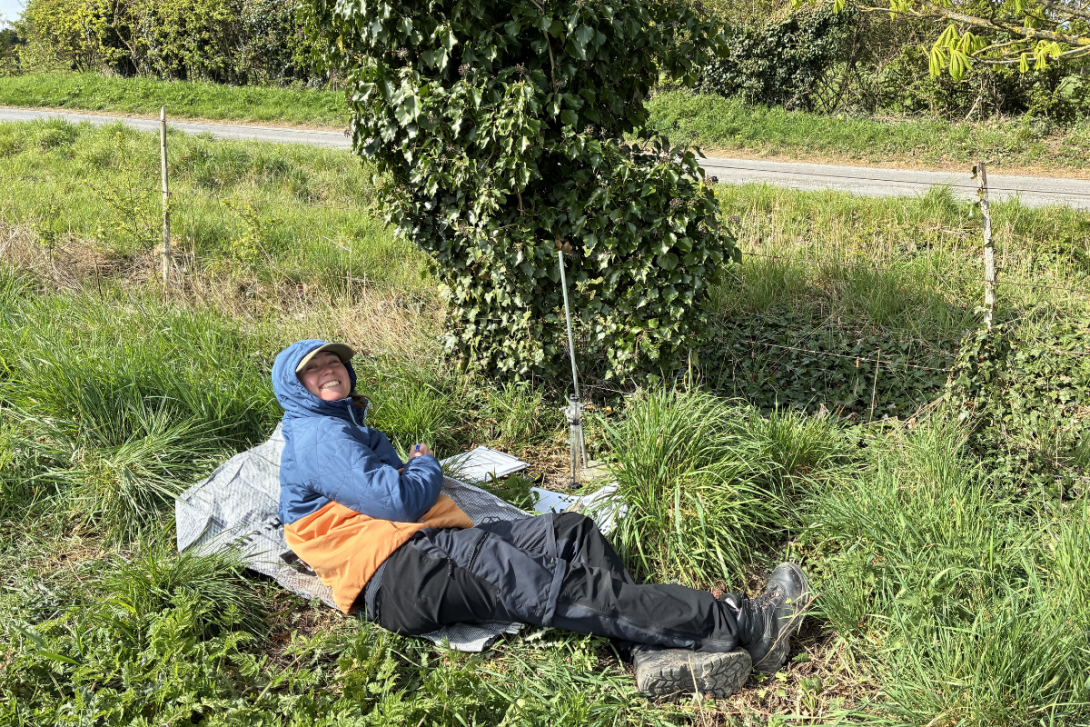
Picture: infiltration test at Upper Thames conventional agricultural practice site (infield, where crops grow). (Neeraj Sah, UKCEH)
In the Thames basin, agriculture dominates the landscape. Decades of intensive farming and heavy machinery have reduced the soil’s ability to absorb and retain water.
Today, farmers are testing regenerative practices, while researchers monitor how these approaches can restore the soil’s natural ‘sponge’ function.
Comparing regenerative and conventional farming practices
Researchers are studying several farms across Oxfordshire , comparing how different farming approaches impact soil’s health. These include:
- Two agricultural sites implementing regenerative practices such as no-till farming, cover crops, and fallow periods.
- One agricultural site following improved conventional practices (adding manure and earthworms in the field).
- One grassland site practising regenerative grazing with cattle.
The goal is simple: understand how these practices influence the soil’s ability to retain and slowly release water, which is crucial for both flood mitigation and drought resilience.
What is measured and how?
Researchers carry out fieldwork to collect soil samples at different depths and conduct infiltration and percolation tests twice every year (autumn and spring). They measure:
- Soil structure (bulk density): less compact soil allows better water infiltration; higher porosity means more water can be stored.
- Soil organic matter: high organic matter levels improve soil structure thus increase water infiltration and retention
- Water movement through soil (hydraulic conductivity): indicates how easily water moves through the soil under different moisture conditions.
Soil with high porosity and organic matter can store large amounts of water, helping reduce runoff during heavy rainfall and sustain crops during dry periods.
These measurements are combined with long-term datasets from previous projects, providing a strong evidence base for understanding changes over time.
.png)
Picture: infiltration test at Upper Milton site in May 2025 (Neeraj Sah, UKCEH)
Promising results... with some surprises
Early findings highlight clear benefits of regenerative practices:
- Higher soil organic matter in regenerative sites.
- Lower soil compaction, allowing better root growth and water infiltration.
- Regenerative grazing shows the strongest impact, with a 26× increase in water infiltration.
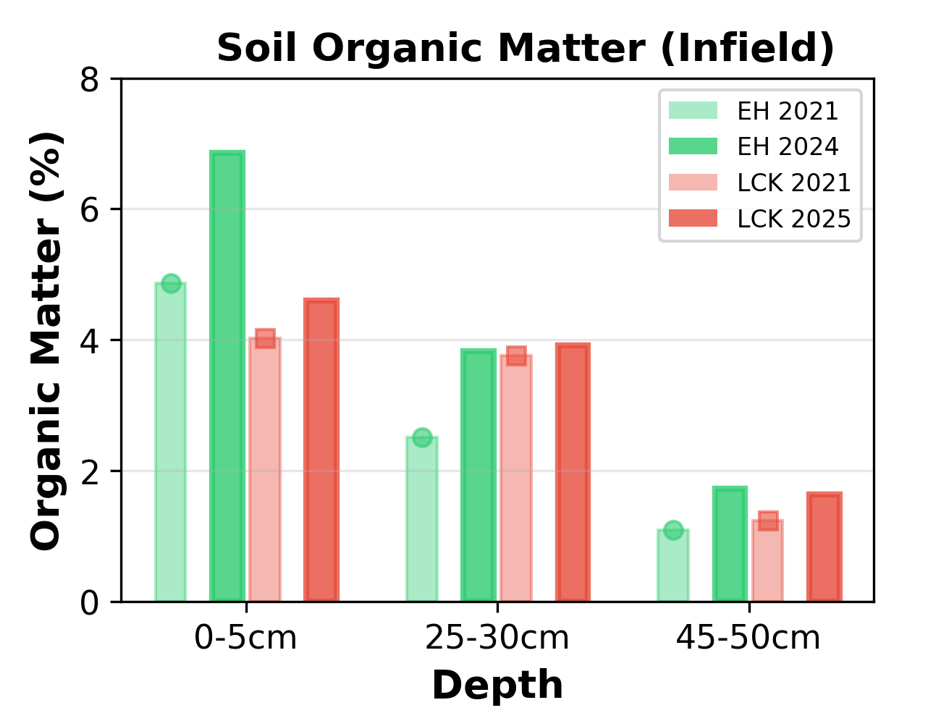
Picture: EH = regenerative practices (no-till farming, cover crops, and fallow periods). LCK = improved conventional farming (strip tillage and organic amendments like manure and earthworms) . The natural accumulation or organic matter at EH indicates how reduced soil disturbance preserves soil carbon. LCK represents improved conventional farming rather than purely conventional methods. Despite these improvements, EH's no-till approach achieves higher organic matter naturally.
However, some results are more nuanced. Bulk density (soil compaction) has changed in unexpected ways at regenerative sites: while it remains below critical thresholds, compaction has not decreased as much as expected. This highlights the complexity of soil systems and the need for long-term monitoring.
Soil is a key part of water management
By improving soil health, regenerative agriculture can:
- Reduce flood risk by improving the soil's ability to absorb rainfall;
- Increase drought resilience by storing more water;
- Support healthier ecosystems.
However, transitioning to these practices takes time and must remain economically viable for farmers.
Looking ahead
Ongoing monitoring will continue to track how soil properties evolve, including new indicators such as earthworm activity and soil chemistry.
By combining field data with long-term research, SpongeScapes aims to build stronger evidence on how agricultural practices can restore the soil’s sponge function, and support more resilient landscapes in the face of climate change.