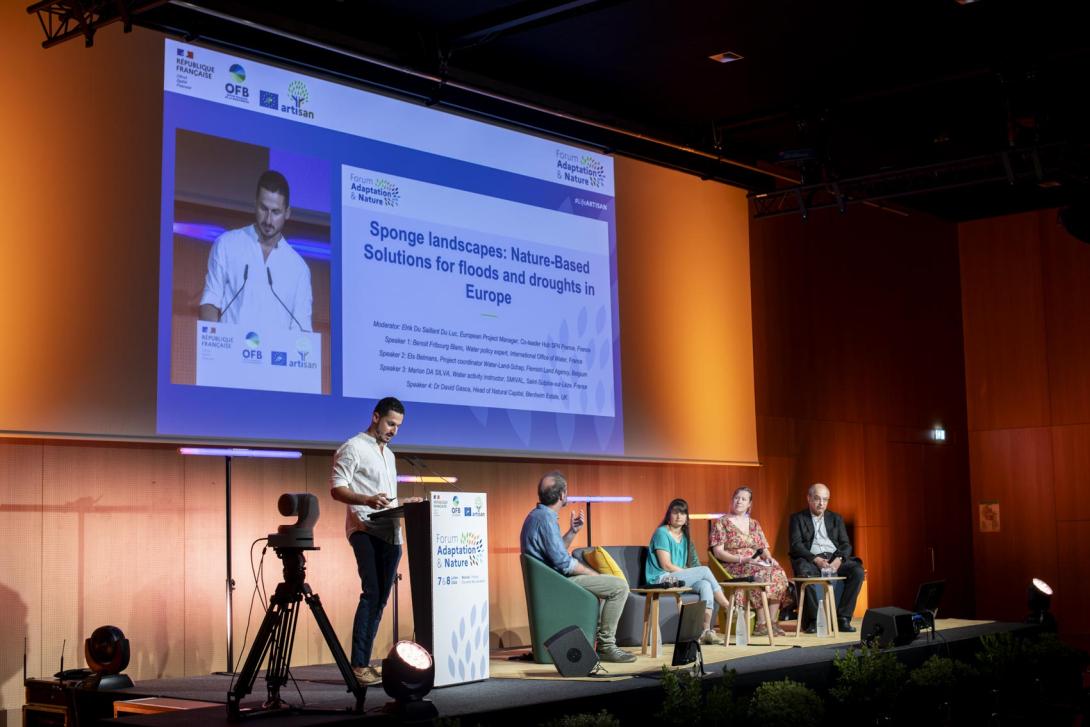
As part of the LIFE ARTISAN Adaptation & Nature Forum 2026 in Rennes on 7-8 July 2026, SpongeScapes and SpongeWorks jointly organised the European roundtable "Sponge landscapes: Nature-based Solutions for floods and droughts in Europe" on 8 July, bringing together experts from across Europe to discuss how sponge measures can strengthen climate resilience.
The session marked France's National Sponge Day for the SpongeScapes project while also serving as a key Community of Practice (CoP) event for SpongeWorks, helping strengthen the emerging network of sponge measure practitioners in France and sharing experience from other European countries.
The discussion highlighted how restoring the natural sponge function of landscapes can reduce flood risks, improve drought resilience and deliver multiple benefits for biodiversity, agriculture and water management.
Sharing experiences from across Europe
The roundtable was moderated by Elrik Du Saillant du Luc, European Project Manager at SEMIDE, the European Economic Interest Group led by the International Office for Water (OiEau). Specialising in the development of nature-based solutions in urban areas, he also serves as co-chair of the French National Nature-based Solutions Hub, helping connect European research, policy and practitioners working on climate adaptation.
Under his moderation, the panel brought four speakers presenting complementary perspectives on sponge landscapes:
Benoît Fribourg Blanc (International Office for Water, OiEau, France), who explained how European research projects are strengthening the scientific knowledge on sponge landscapes across Europe.
Els Belmans (Flemish Land Agency, Belgium), who presented the “Water-Land-Schap” programme where local coalitions implement several sponge measures as part of their action plan for drought and flood. She illustrated how integrated landscape management can improve water resilience while supporting agriculture and rural development.
Marion Da Silva (Syndicat mixte interdépartemental de la vallée de la Lèze, SMIVAL, France), local co-coordinator of the French SpongeWorks demonstrator, who shared experiences from the Lèze River basin and highlighted how sponge measures are being implemented on the ground through close cooperation with local stakeholders.
David Gasca (Blenheim Estate, United Kingdom), who presented the “Making Space for Water” initiative and demonstrated how large estates can restore water retention across landscapes, as well a promote soil health, protect natural habitats and build social value.
From science to implementation
Throughout the discussion, speakers stressed that sponge measures are a practical and cost-effective response to increasingly frequent floods and droughts. While they are not a solution to every extreme event, they represent a "no-regrets" approach that simultaneously improves biodiversity, soil health, water quality and landscape resilience to climate change.
The session also highlighted the importance of combining robust scientific evidence with long-term governance, local engagement and knowledge exchange to successfully scale up sponge measures across Europe.
By bringing together researchers and practitioners, the roundtable demonstrated how collaboration across projects and countries is helping accelerate Europe's transition towards more resilient sponge landscapes.